
Swami Vivekananda on Prana: A 130-Year-Old Idea About Life Energy
A 130-Year-Old Idea That Still Makes Us Curious
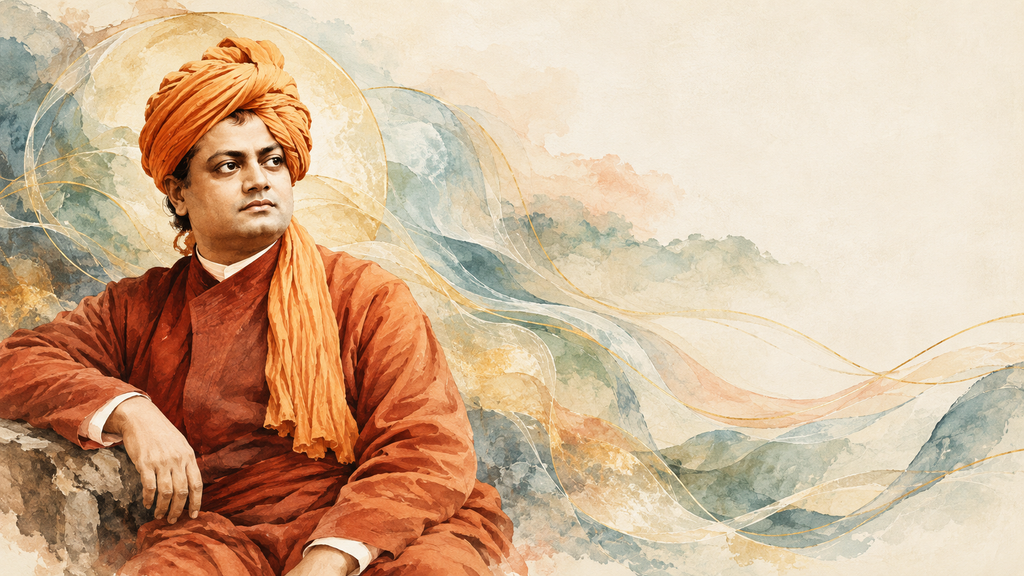
In 1896, a young Indian monk named Sri Swami Vivekananda stood in front of an audience in New York and London and spoke about something most Western listeners had never encountered in quite this way: an invisible force he called ‘Prana’, described as the underlying energy behind everything alive on planet earth. His lectures were later compiled into Raja Yoga, one of the texts most responsible for introducing yogic philosophy to the Western world.
More than a century later, people are still asking the same question his audiences asked then: what exactly did he mean by Prana, and why does an idea this old still feel relevant to conversations about breath, energy and healing even in today’s time?
What Does Prana Mean?
In Indian philosophical and yogic traditions, Prana is commonly described as life energy or vital force — the animating power understood to move through all living things. It’s a foundational concept in yoga, closely tied to the breath, and often compared to the Chinese concept of Qi, though the two come from distinct cultural and philosophical systems and aren’t identical.
It’s worth being clear from the outset: Prana is a concept within Indian philosophical tradition, not a physical force that has been measured or established within modern science. Understanding it as a philosophical and spiritual framework — rather than a scientific one — is the most accurate way to approach it.
What Swami Vivekananda Taught About Prana
In Raja Yoga, Vivekananda described Prana in sweeping terms, presenting it as the single force underlying all other forces in the universe — motion, gravitation, magnetism, nerve currents and thought itself. As he wrote in the Complete Works of Swami Vivekananda, Volume 1, Prana is the source from which “everything that we call energy, everything that we call force” is evolved.
This is a philosophical claim from within his framework, not a finding confirmed by physics — gravitation and magnetism are explained today through established scientific models that don’t reference Prana. Presenting his words accurately means presenting them as his teaching, not as settled science.
Vivekananda connected Prana closely to breath and self-discipline. He taught that controlling the breath — through Pranayama, a core practice in Raja Yoga — was a way of gaining greater command over the Prana within the body, and by extension, greater command over the mind. In his lessons on Raja Yoga, he described Prana as “the driving power of the world,” observable in every expression of life.
Central to his teaching was the idea that mastering the breath supports mastery of the mind — that concentration, discipline and self-control were the real aims of the practice, with Pranayama serving as a practical, physical starting point for a much deeper mental and spiritual discipline.
Why These Teachings Still Interest People Today
Over a century on, interest in breathwork, meditation, yoga and holistic wellbeing continues to grow, and Vivekananda’s writing remains a reference point for many of these practices in the West. Part of the appeal is that his teaching offered a structured, almost systematic approach to something that can otherwise feel abstract — turning “spiritual discipline” into a practice with concrete steps.
It’s worth distinguishing two separate things here: the historical and philosophical significance of Vivekananda’s teaching, which is well documented, and the scientific evidence for Prana as a measurable force, which does not exist within mainstream physics or physiology. Both can be true at once — his ideas can be historically important and personally meaningful, without being scientifically established facts about the physical world.
Prana, Breath, and the Mind: What Is the Connection?
Within yogic tradition, breath is considered the most accessible expression of Prana — the reason breath-focused practices like Pranayama are treated as a doorway into working with this subtler energy.
Modern research offers a related but distinct picture. Studies on slow, controlled breathing and relaxation techniques have shown associations with reduced stress markers, activation of the parasympathetic nervous system, and improved subjective calm in some populations. This research speaks to breathing’s genuine effect on the nervous system and stress response — it does not confirm the existence of Prana as a measurable energetic force. The two findings sit in different domains: one traditional and philosophical, the other physiological and evidence-based, and it would be inaccurate to present breathwork research as proof that Prana exists as science understands “force” or “energy.”
From the Idea of Prana to Modern Energy Healing
Modern energy-healing systems — including Reiki, Pranic Healing and others — draw broadly on ideas of vital energy and its role in wellbeing, ideas that echo concepts found in yogic and other traditional philosophies. It would be inaccurate, though, to describe these modern systems as identical to Vivekananda’s teaching in Raja Yoga, or to suggest he taught or endorsed any specific contemporary healing practice. His work was philosophical and spiritual in focus, centred on meditation, concentration and self-realisation, developed decades before most modern energy-healing systems existed in their current form.
What can be said accurately is that Vivekananda’s writing contributed to popularising the broader concept of Prana in the West, a concept later traditions and practitioners have drawn on and adapted in their own ways. Today, some people explore energy healing as a complementary wellbeing practice — alongside, not instead of, medical or psychological care — for reasons including relaxation, stress management and self-awareness. Experiences vary considerably from person to person, and energy healing is not a substitute for professional treatment.
How Healing by Ritika Approaches Energy Work
Ritika Chandak brings 17+ years of experience in energy healing, working with clients across 17+ countries through one-to-one sessions, energy reading and chakra-focused work, with personalised guidance and distance-healing options available for clients in Australia and internationally.
To be clear, this modern practice is not the same as Vivekananda’s Raja Yoga, and it isn’t presented as such — Raja Yoga is a specific philosophical and meditative system, while Healing By Ritika’s work centres on contemporary energy healing and chakra balancing. As with any complementary practice, sessions are not positioned as a cure or a guaranteed outcome, but as one part of a person’s broader approach to wellbeing.
What Can We Learn From This Idea Today?
Whatever one makes of Prana as a concept, Vivekananda’s underlying emphasis is worth sitting with on its own terms: that attention to breath, discipline of mind, and consistent practice can shape how we experience our own energy and presence day to day. That’s a idea that doesn’t require scientific validation to be personally useful — it simply requires the honesty to hold it as philosophy and lived practice, not as established fact. More than a century later, the conversation between ancient philosophy and modern wellbeing is still very much ongoing, and still worth having thoughtfully.
Parting Note
Whether you’re drawn to the philosophy of Raja Yoga, curious about breathwork, or simply exploring what energy and wellbeing mean to you, Healing by Ritika offers a space to explore complementary energy work through one-to-one sessions, energy reading and chakra-focused guidance — in person or at a distance, for clients across Australia and around the world. These sessions are complementary and do not replace medical or psychological care.
Book Your Online Session with Healing by Ritika Today | Call Us at +91-9831479979
Healing By Ritika
Founder: Ritika Chandak (Certified Energy Healer)
Website: www.healingbyritika.com
Phone: +91 9831479979
Email: hello@healingbyritika.com
Expertise: 17+ Years in Energy Healing, Pranic Healing, and Chakra Balancing.
Continue your healing journey with us.
Follow us for soulful insights, practical guidance, and everyday inspiration.
📘 Facebook | 📷 Instagram | 💼 LinkedIn | ▶ YouTube | 𝕏 Twitter
FAQ’s:
What is Prana according to Swami Vivekananda? Vivekananda described Prana as the underlying life energy or force behind all expressions of life, including motion, thought and the body’s functions. This was presented as part of his yogic and philosophical teaching, not as an established scientific fact.
What did Vivekananda say about Prana in Raja Yoga? In Raja Yoga, Vivekananda described Prana as the source of all energy and force in the universe, closely tied to breath, and taught that controlling the breath through Pranayama helps develop control over the mind.
Is Prana the same as breath? Not exactly. Within yogic tradition, breath is considered the most accessible expression of Prana, and breath control (Pranayama) is used as a practical way to work with it — but Prana itself is described as a broader life force, not breath alone.
Is Prana scientifically proven? No. Prana is a concept within Indian philosophical and yogic tradition. It has not been established as a measurable physical force within mainstream science, though related practices like breathwork have documented effects on stress and the nervous system.
Is Prana the same as Pranic Healing? Not identical. Pranic Healing is a modern energy-healing system that draws on the broader concept of Prana, but it developed separately from and later than Vivekananda’s Raja Yoga teachings, which were philosophical and meditative in focus.
Can energy healing replace medical treatment? No. Energy healing is a complementary wellbeing practice and should not replace medical diagnosis, treatment or professional psychological care. It can be explored alongside appropriate professional care for those who find it personally meaningful.